     
|
|||
| . | |||
|
The mission of GeoGuardian Geoguardian has been operating since 2005 and presents environmental content created using satellite imagery, GIS (Geographic Information Systems), and data visualisation techniques. Geoguardian will introduce undergraduate-level Remote Sensing and GIS lessons in 2026. Also, I do online lectures in Remote Sensing and GIS, including how satellite imagery can be used to monitor and map natural disasters - Dr Kithsiri Perera, Australia. Please send your comments and inquiries to "pererausq@gmail.com" |
|||
| . |
|
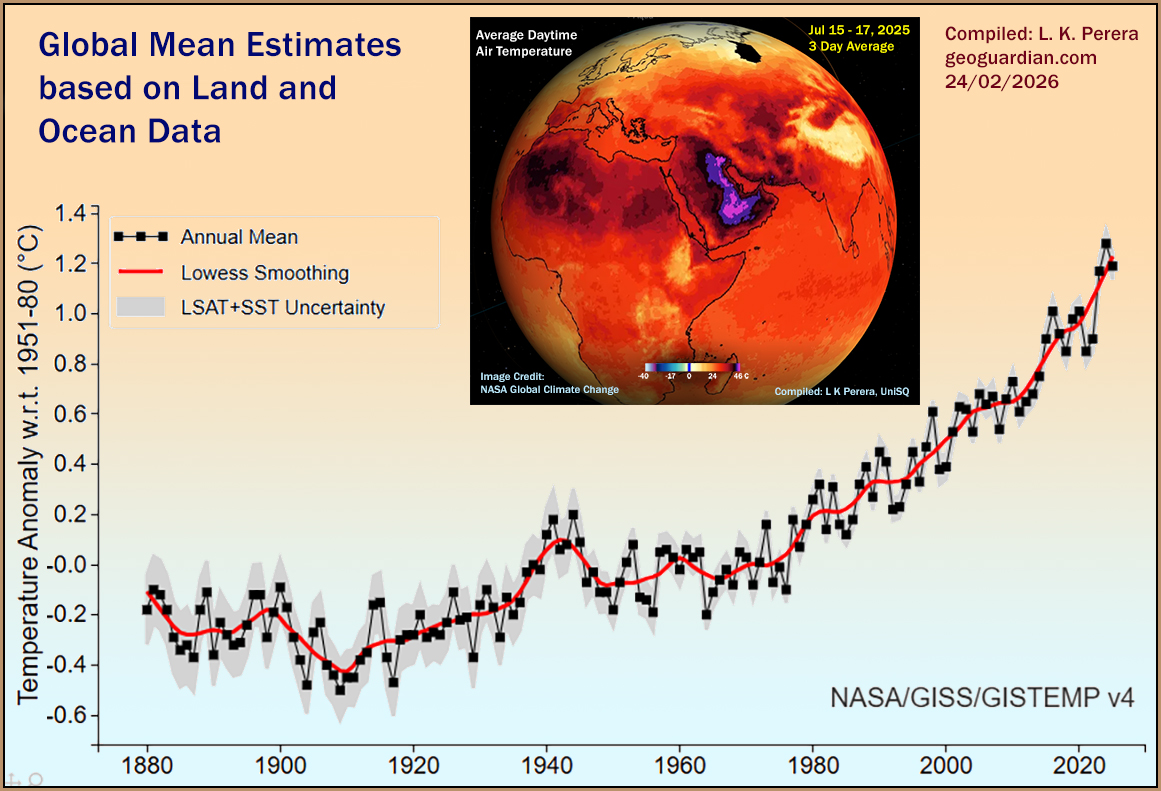
Latest Environmental Content Increasing Global Temperature 2026/02/24 This is the latest graph of the trend in global temperature anomalies produced by the GISS Surface Temperature Analysis project at NASA. I have added the image I extracted from NASA and published in Jul 2025, too, to demonstrate the extreme temperature event recorded last year. According to NASA calculations, the mean temperature anomaly has been steadily increasing since the 1960s, and the world may experience more frequent climatic changes and extreme events in the next few decades. |
|
|
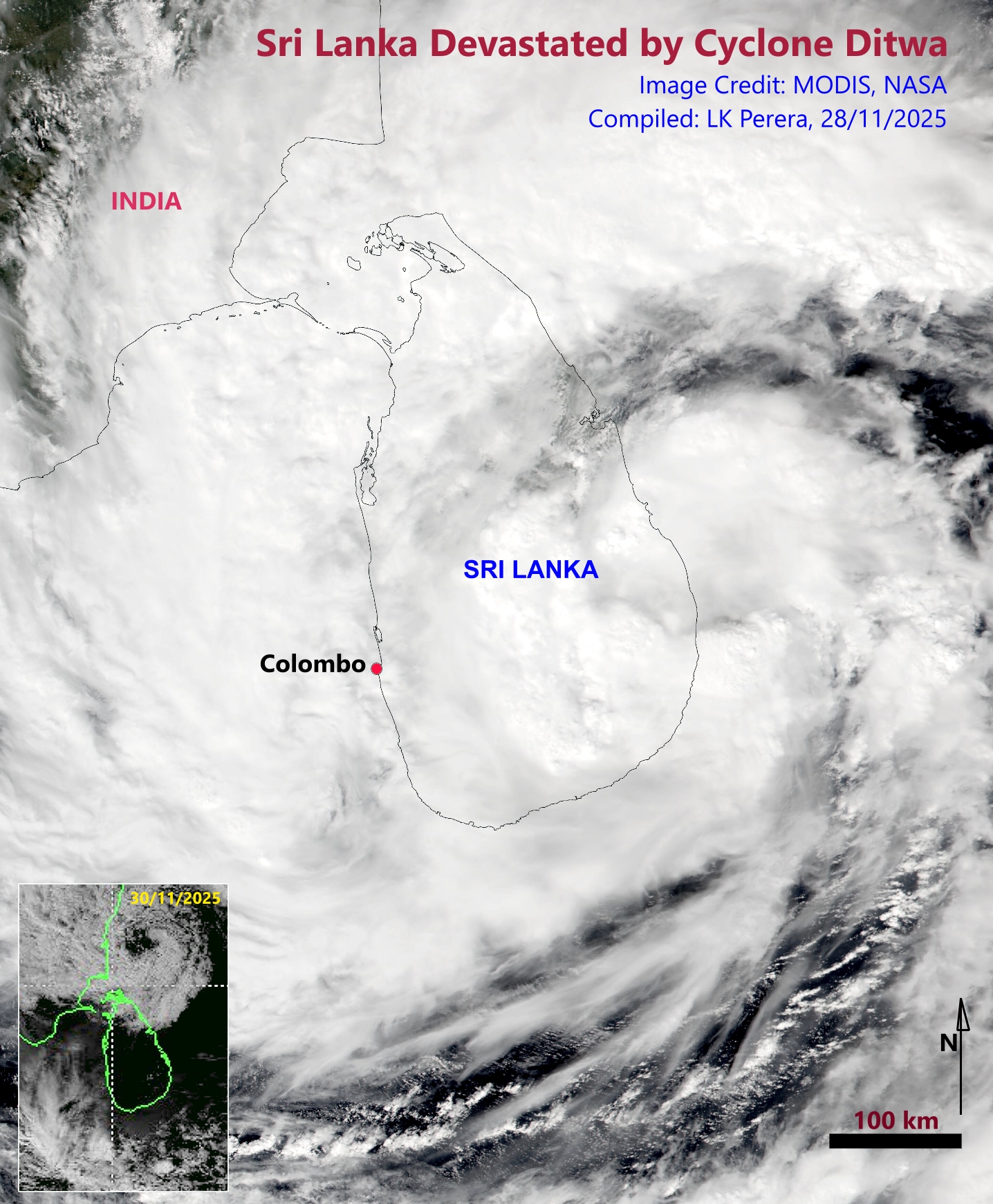
The Killer Cyclone Ditwah Devastated Sri Lanka 2025/11/30 The Cyclone Ditwah has ruined Sri Lanka by killing over 335 people while missing another 360 people by landslides and floods by 1st Dec, 2025. This became the worst cyclone disaster in recent history after the 2003 flood disaster. The cyclone brought around 1000mm of rainfall over 2-3 days across most regions, resulting in deadly floods and landslides across various parts of the island. According to the government data, about 147,000 people were forced to evacuate, and the overall disaster has impacted about 1 million people. The image shows the cyclone's peak conditions, and the inset image from the Himawari satellite shows the cloud cover on 30th Nov, indicating the cessation of rainfall. |
|
|
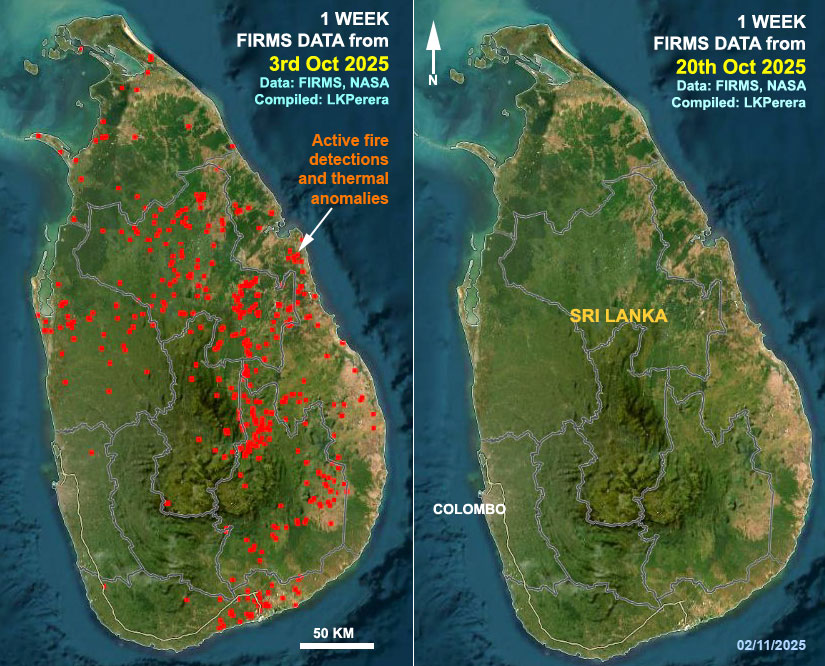
Warm and wet Sri Lanka by NASA's FIRMS data 2025/11/02 NASA's Active Fire Detections and Thermal Anomalies data, or FIRMS (Fire Information for Resource Management Systems), provides a valuable view of global-scale Earth surface conditions. I noticed this rare image after recent heavy rains occurred in Sri Lanka. The 1-week accumulation of FIRMS data from 3rd Oct shows the detected spots in most regions of the island. After the heavy Northeast Monsoon rains, no spot has been detected as of the week that started on 20th October. Even though this observation may seem simple, there are numerous application potentials for this type of temporal monitoring. According to NASA documents, these worm spots are attributed to the warmer Earth's surface resulting from natural fires, fires from lightning, volcanoes, and intentional fires set by humans. However, these data are considered provisional and should be used with caution by users. |
|
|
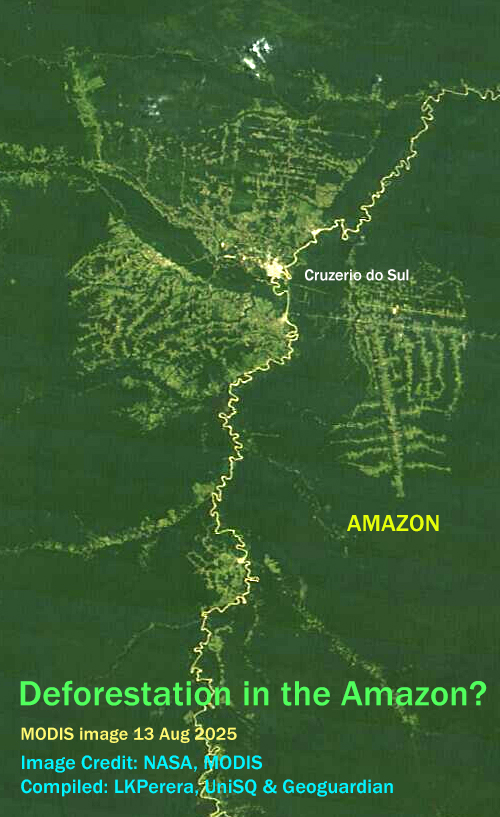
Deforestation in Amazon ? 2025/09/02 Deforestation is a significant issue around Cruzeiro do Sul, Brazil, driven by the expansion of agribusiness like cattle ranching, logging, and the construction of roads. Road construction, such as the proposed Pucallpa-Cruzeiro do Sul highway, is particularly concerning because it correlates highly with increased deforestation, as it provides access to remote areas for illegal logging and other activities. The image shows the present status of the region capturered by MODIS satellite system. |
|
|
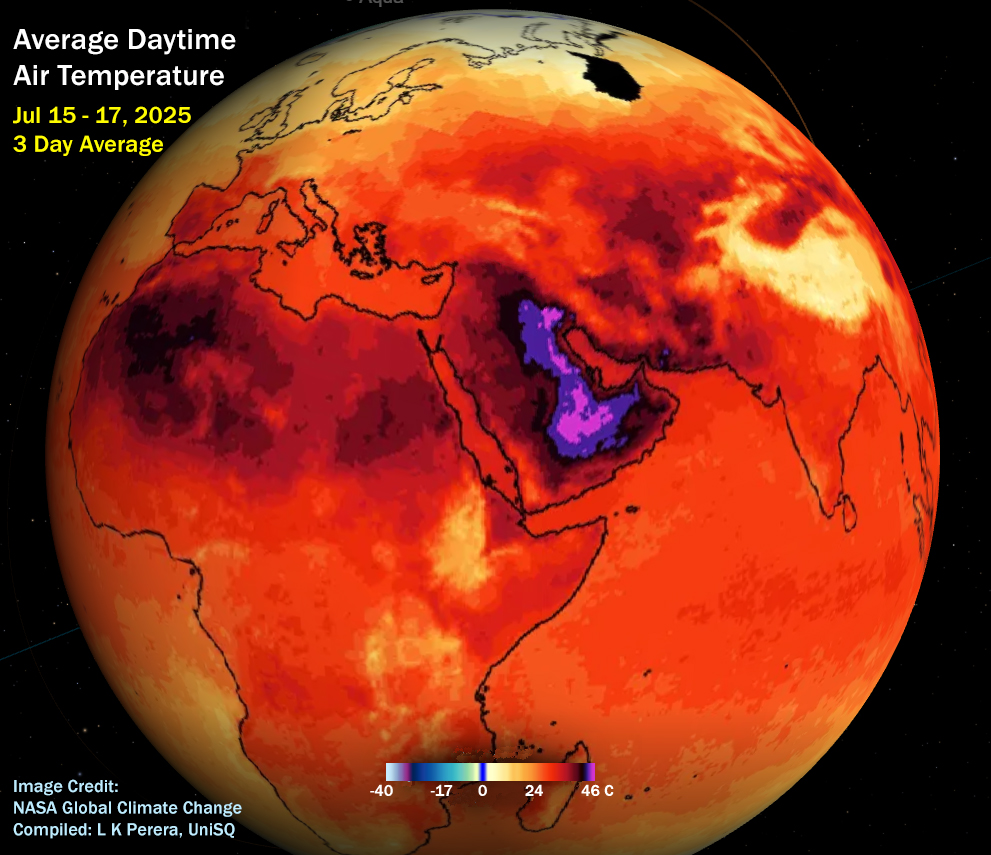
Burning summer in Saudi Arabia 2025/07/18 Burning summer in Saudi Arabia. The hot summer is a common occurrence in this region; however, NASA’s 3-day average daytime surface temperature image shows a fascinating image of the warmth. Summers in the central region of the peninsula are extremely hot and dry, ranging from 27°C to 43°C in the inland areas and 27°C to 38°C in coastal regions. In winter, the temperature ranges between 8°C to 20°C in the interior parts. When observing the global surface temperature data, this image shows a sharp increase in temperature only in Saudi Arabia's inland regions. |
|
|
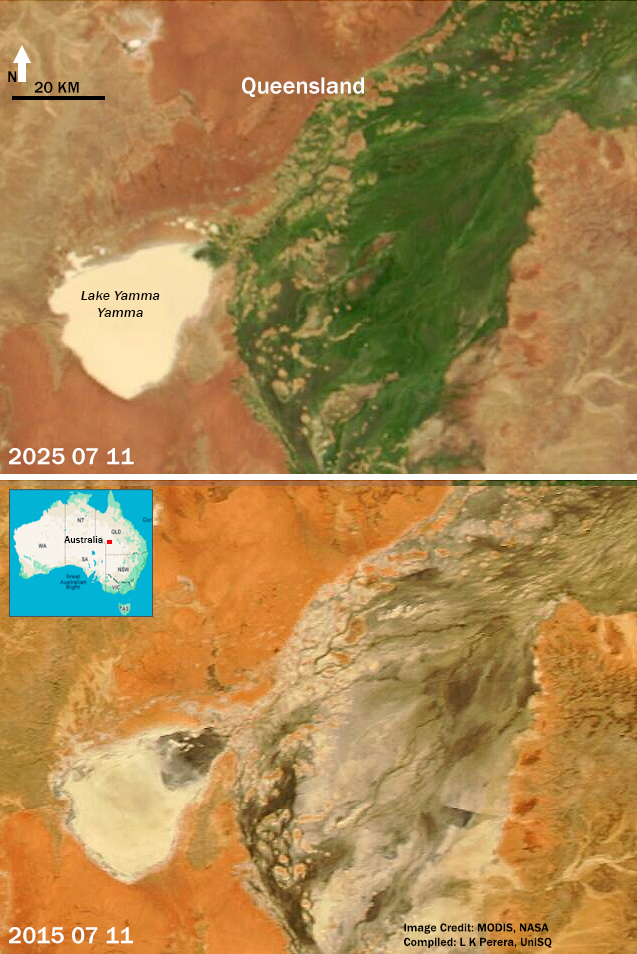
The Lake Yamma Yamma 2025/07/14 Lake Yamma Yamma is the largest ephemeral lake in Australia, located in Southwestern Queensland. Ephemeral lake water levels do not last long, but they can transform a lake when sufficient rainfall occurs. These two MODIS 250m resolution images are from 2015 and 2025, taken on almost the same day in July. When visually observing the image characters, it is clear that multitemporal satellite images are highly suitable for analyzing not only the land cover changes, but also to extend studies into the impact on biodiversity, etc. The July 2025 image shows the lake with water and greenery compared to the 2015 image. The average rainfall around the lake region for the 6 months ending June in 2015 was lower (50 – 100mm) than in 2025 (200-300mm) (BOM data). |
|
|
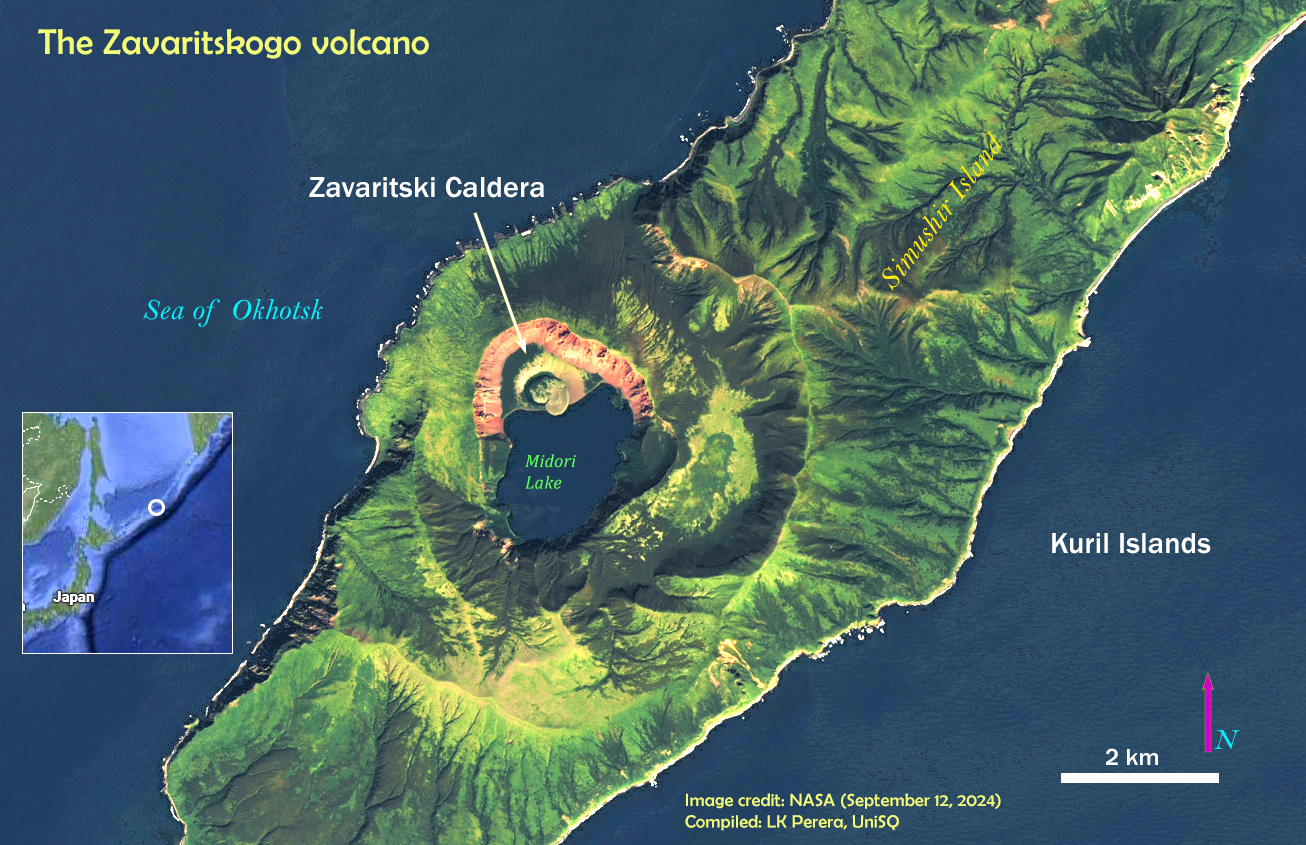
The Zavaritskogo volcano 2025/01/18 The Zavaritskogo volcano (also called Zavaritskii) is a striking feature on Simushir Island, in the middle of the Kuril Islands archipelago. It is made up of nested, steep-walled calderas surrounding a central lake (Midori Lake). This fascinating image was captured by Imager) on Landsat 8 satellite on September 12, 2024. Humans very sparsely populate these islands. |
|
|
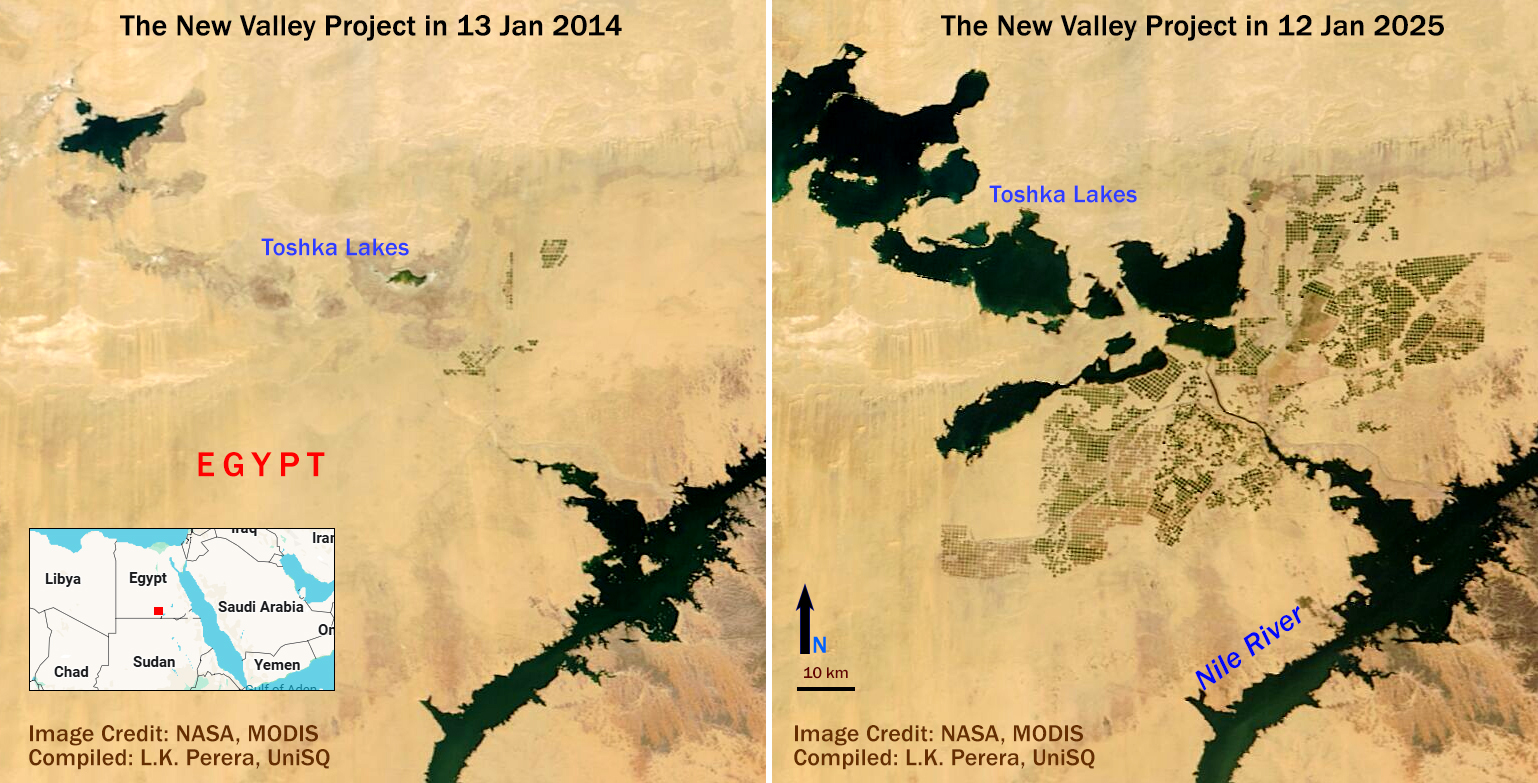
Toshka Project - Egypt 2025/01/18 The New Valley Project or Toshka Project - I accidentally found this 2025 MODIS image of Egypt, which shows an amazing greenery project in the Sahara desert west of the Nile River. I checked historical images of the same location and found that the Toshka Lakes region is a major agricultural development project in Egypt. However, the region had very few green patches 10 years back (2014 image) with the dry conditions of the lake system. Within 10 years, Egypt's New Valley Project has had a tremendous improvement, as you see in the 2025 MODIS image. This is a suitable topic for remote sensing for the undergraduate-level project. There are enough historical cloud-free MODIS images available from NASA. |
|
|
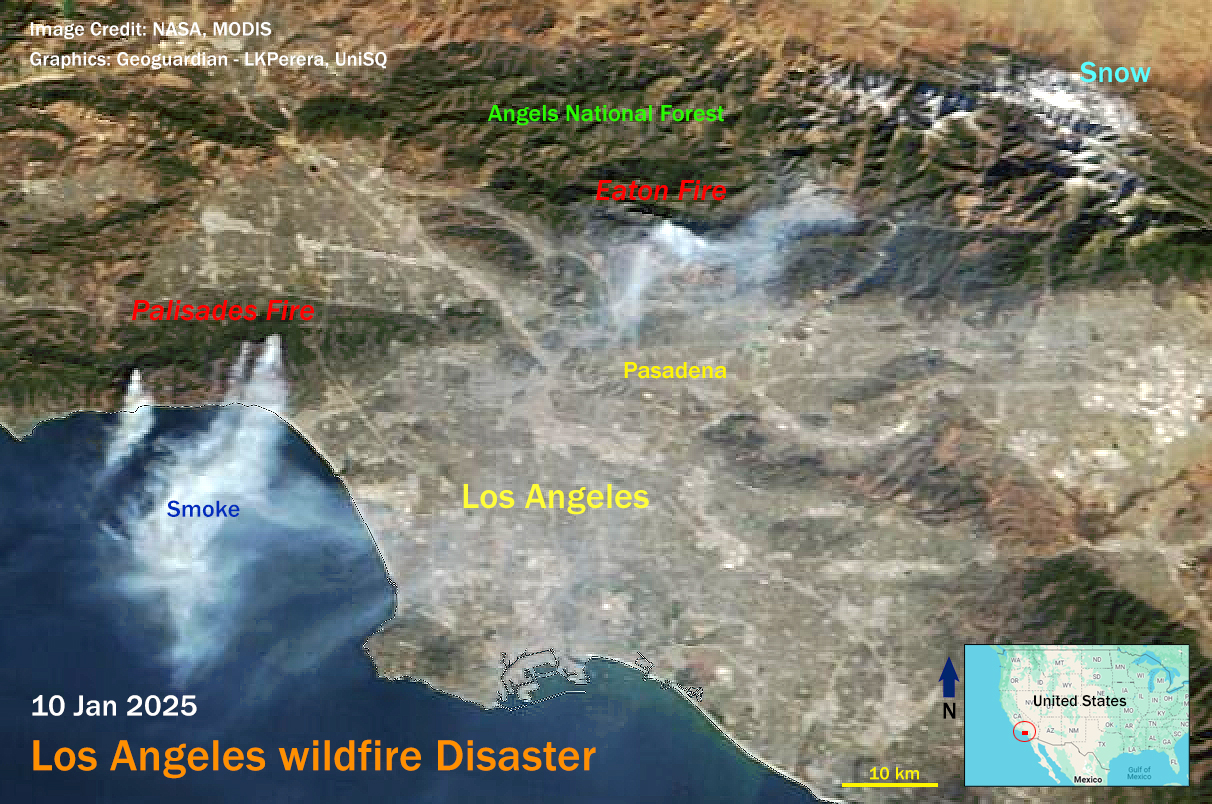
Los Angeles Wildfire Disaster 2025/01/10 The Los Angeles Forest fire became one of the most disastrous wildfires in the history of the UN. This image shows fire spots and massive smoke recorded by MODIS satellite on 9th Jan 2025. |
|
|
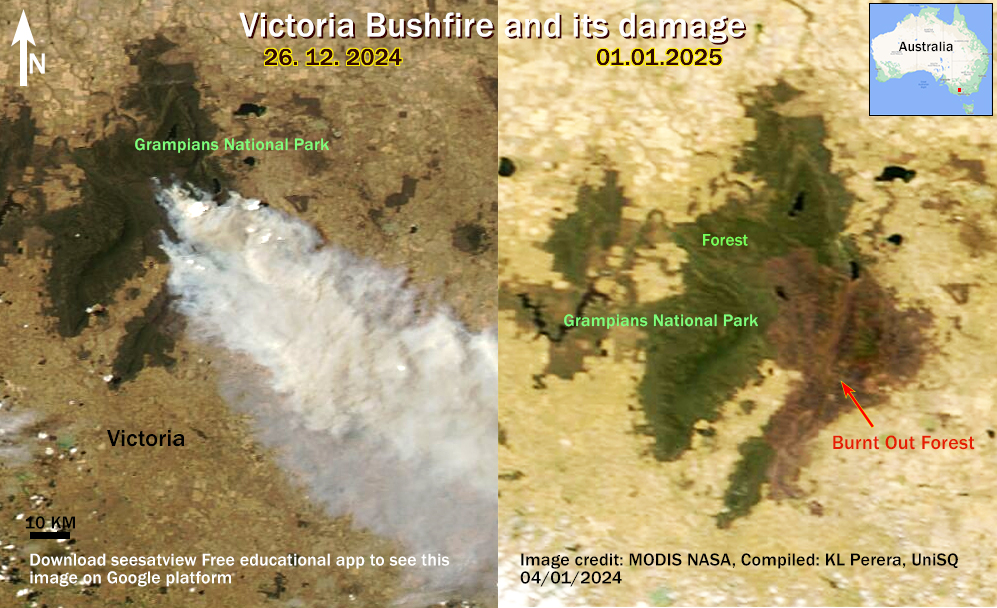
Victoria Bushfire from Space 2025/01/04 A large forest area in Grampians National Park in western Victoria has been burnt out by bushfire, which started in the last week of December. 2026. The impact on human life is limited, and according to ABC News Australia, about four houses have been lost due to the fire. However, significant damage to the forest park can be presented by the latest MODIS satellite image, acquired on 1st Jan 2025. As you can see in the 1st Jan image, the eastern half of the forest park shows the burnt-out area in a brownish colour. |
|
Home | Archive | Maps | Links | About Geoguardian | Disclaimer
geoguardian.com © Est. 2005. All rights reserved. Please write your comments

geoguardian.com © Est. 2005. All rights reserved. Please write your comments